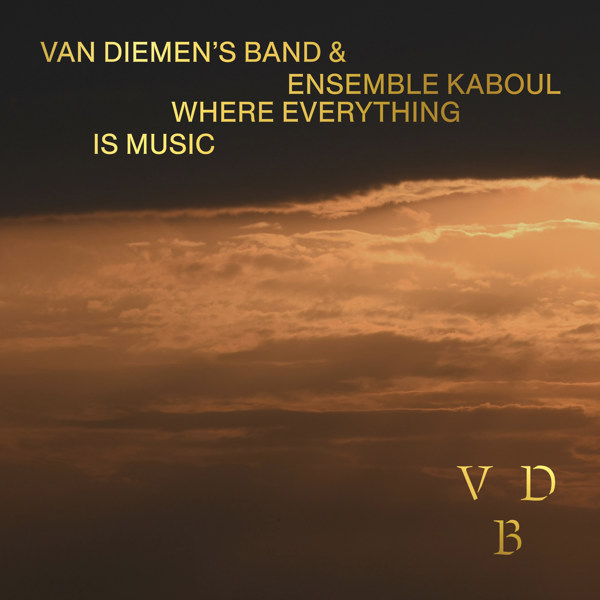
Where Everything is Music
Now available to pre-order
The Persian music of Afghanistan meets Baroque in this acclaimed cross-cultural collaboration with Ensemble Kaboul.
Experience a stunning blend of two distinct musical worlds, when the warm, resonant tones of Van Diemen's Band meets the intricate melodic patterns of traditional Afghan and Persian music, while soaring vocals merge with the ethereal late 19th century piano compositions of Erik Satie.
Embodying artistry and advocacy, this recording preserves and celebrates musical traditions Afghanistan's current regime is attempting to silence.
Recorded at Frying Pan Studios 29 September - 3 October 2025.
Where Everything is Music will be released on the VDB label in April 2026 and will be available on all major streaming platforms and CD format.
Pre-order your copy today
DELIVERY SCHEDULED FOR APRIL 2026
Recorded at Mona's Frying Pan Studios in September-October 2026, the latest release on the VDB Label features the acclaimed collaboration between VDB and Ensemble Kaboul.
Working with Van Diemen’s Band has been one of the most meaningful artistic journeys of my recent years.
I first collaborated with the ensemble in 2023, and since then our musical dialogue has grown into something far deeper than a professional partnership. Returning to Tasmania in September 2025 for our second project together felt like coming back to a musical family.
This recent recording in Hobart was centred around a programme that brought together traditional Afghan pieces, works proposed by Van Diemen’s Band, and original compositions by my dear friend and outstanding virtuoso Luke Plumb, through whom this collaboration was first initiated. His artistic vision created the bridge that allowed our musical worlds to meet.
The project was further enriched by the beautiful and refined arrangements of the ensemble’s harpsichordist and classicist, Donald Nicolson, whose sensitivity to texture and structure gave the repertoire both clarity and depth.
On the Afghan side, the presence of the remarkable singer Siar Hashimi and his brother, the percussion virtuoso Masud Hashimi, brought a particularly powerful and moving dimension to both the concert performances and the recording sessions. Their expressive intensity, rhythmic vitality, and deep connection to the Afghan tradition added authenticity and emotional depth to the project. In the studio especially, their musical dialogue with the ensemble created moments of rare sincerity and spontaneity.
What moves me most about this group is not only its extraordinary artistic level, but also its openness — the generosity with which it embraces different traditions and allows them to breathe within early music practice.
Over time, I have developed deep affection and sincere friendship with the musicians. There is a rare authenticity in the way this ensemble listens — to one another, to history, and to the present moment. Our collaboration is built on trust, curiosity, and shared emotion.
I am profoundly grateful to be part of this musical adventure and look forward to the next chapters we will create together.
Khaled Arman
Ensemble Kaboul
There are moments in music when the distance between cultures dissolves — when two entirely different traditions, shaped by different histories, different instruments, different centuries, find that they have always, in some sense, been speaking to one another.
This recording is one of those moments.
Van Diemen's Band, whose work is rooted in the music of seventeenth and eighteenth century Europe, and Ensemble Kaboul — three Afghan musicians of extraordinary distinction, Khaled, Siar and Masud — have come together to explore the threads that quietly connect Western classical music with the profoundly rich musical heritage of Afghanistan.
The program moves in both directions: Van Diemen's Band perform arrangements of melodies from Afghanistan's deep and ancient tradition — tunes that any Afghan would know and carry in their heart, speaking of home with an intimacy no prohibition can erase. The musicians of Ensemble Kaboul, meanwhile, bring their distinctive voices to works from the Western classical tradition, pieces chosen precisely because they elude easy categorisation, offering the perfect common ground for two traditions to meet and play. What emerges is not a collision, but a conversation: tender, generous, and deeply human.
This collaboration carries a weight beyond the purely musical. The musicians of Ensemble Kaboul are masters in the fullest sense — yet they are no longer free to play their own music in the country of their birth. Sit with that for a moment. And yet here they are, not diminished but defiant, sharing that music with the world, ensuring it is heard, preserved, and honoured.
To play alongside them is a privilege. Within moments of beginning, the differences of tradition fall away, and there is only the music itself — alive and shared.
This is an act of preservation, and a reminder that people from vastly different worlds can create something genuinely beautiful together. These musicians are proof of that. Every note is offered with craft, with humility, and with love.
Julia Fredersdorff
Artistic Director, Van Diemen's Band
| Ensemble Kaboul |
KHALED ARMAN rubab |
| Van Diemen's Band |
JULIA FREDERSDORFF Artistic Director & Baroque violin
LUKE PLUMB mandolin
KATIE YAP Baroque violin
RACHEL MEYERS viola
LAURA VAUGHAN viola da gamba & violone
MARTIN PENICKA cello
DONALD NICOLSON harpsichord
|
ENSEMBLE KABOUL explores the Persian music of Afghanistan, an unrecognised or even forgotten repertoire. In this country, rich with several musical cultures, the traditional and sacred Persian heritage testifies to a remote past and of a particular poetry. Persian cultural influence can be experienced from Lahore to Budapest and from Erevan to Cordoba.
To bring this repertoire back to life, the Ensemble Kaboul works like archeologists in order to rediscover the buried musical themes, the missing ornaments and the lost motifs of a formerly flourishing musical corpus. To renovate these buried mosaïcs, Ensemble Kaboul gathers musicians who belong to a large Persian musical family spread over numerous countries.
KHALED ARMAN (rubab) is one of the most famous players of Afghan lute, the rubab. He introduced the instrument to the Persian, Indian and European music traditions (ancient, classical and contemporary music) when it was strictly associated with the folk repertoire. He has collaborated with viola da gamba players such as Jordi Savall and Vittorio Gielmi, performed with the Grand Eustache Orchestra in Lausanne and with the Quatuor Barbaroque in France. He writes new compositions and orchestrations for Ensemble Kaboul, works inspired by the Afghan tradition and his musical experience while living in France. He fights for the survival of this instrument in his country.
SIAR HASHIMI (tabla, voice) started learning the tabla in Kabul at the age of 4 with teacher Ustad Wali Mohammad. He then completed his training in India and Germany with masters Zakir Hussain, Anindo Chaterjee and Kumar Bose. He began working at a young age with Afghan immigrant artists Farhad Darya, Ustad Mahwash, Amad Wali as well as several big names in Indian classical music such as Hariprasat Chaurasia. In addition to the tabla, he is also a leading exponent of traditional percussion such as the zerbaghali, the dolak, and the daf.
MASUD HASHIMI (zerbaghali, percussion) is recognized as one of the most creative percussion players in the Afghan music industry. Masud has had the opportunity to participate in numerous music festivals around the world, where he has been honored with several prestigious awards. Coming from a musically inclined family, Masud began his musical journey at the age of three. He started learning percussion instruments at a very young age and continued to deepen his knowledge by studying under renowned European and Afghan instructors. Today, Masud is a well-known figure within the modern Afghan community across Europe and the United States. He frequently performs on stage with some of the most famous Asian artists, captivating audiences with his rhythm and talent.
‘Where everything is music…’ (Rumi, 13th century)
Van Diemen’s Band’s fourth album on the in-house label VDB captures their cross-cultural collaboration with members of the legendary Ensemble Kaboul – created for MONA FOMA 2023 and toured nationally to critical and audience acclaim in 2025.
Ensemble Kaboul's practice encompasses both advocacy and preservation, using performance to keep alive a musical culture that Afghanistan’s current regime is attempting to extinguish. What emerged during the initial collaboration with VDB was a stunning composite of two distinct musical worlds, mixing the caramel sounds of VDB’s gut strings with traditional Eastern instruments, and the melismas of Afghan singing with the quixotic late nineteenth-century piano music of Erik Satie. Persian music has been arranged and developed for this unusual (but entirely harmonious) combination, and Western music has been chosen for its fluid and indistinct style, providing a vehicle to unite the oriental sound world with occidental traditions.
Khaled Arman has made the arrangements of the Afghan songs in the program. Composer and singer Fazel Ahmad Zekrya, also known as ‘Naynawaz’ (“The Reed Player’) wrote AY NAYNAWÂ fifty years ago to a poem by the famous Sufi mystic known as ‘Rumi’. It describes the ney’s (or reed-flute’s) longing to return to its reed bed as an analogous reference to the pain of separation from one's native realm and the maturation of a human being.
BA TU DEL DÂDAM is a popular love song that Afghans sing during festivals; in what will become a typical cross-generic gesture in this program, Khaled’s version makes a detour towards seventeenth-century French music in the middle of the piece. He does the same in his arrangement of the late twentieth-century Persian instrumental melody NAGHMA-E KABOULI, whose Shur (Phrygian) modal setting invites a juxtaposition with one of the gavottes from J.S. Bach’s Third Suite for lute.
The legendary Naynawaz (who was assassinated in 1979 by the occupying Soviet forces in Afghanistan) also supplies the final song, again in a Khaled arrangement. DAR DÂMAN-E SAHARÂ depicts the mystic wandering in the desert, unaware of the world and whispering the ‘song of existence’:
One who is not attached to earthly things
likes the song of love and spiritual love.
VDB harpsichordist and musicologist Donald Nicolson bends the West towards the East in his arrangements that exploit the capabilities of Ensemble Kaboul’s master musicians, especially improvisation. The melodic line of Erik Satie’s GNOSSIENNE NO. 1, first published in 1893, suggests to Nicolson “…the sounds of the mystical East '' and serves as the starting point for a vocal reimagining by Siar. By contrast, the voices of Hildegard of Bingen’s medieval nuns are removed from her plainchant O VIRTUS SAPENTIE, and its formerly free line nailed down by driving Eastern rhythms in a purely instrumental rendition coloured by ornamental devices from Byzantine and Turkish music, creating a hypnotic effect.
Like many seventeenth-century French writers, Antoine Boesset (1586-1643) was drawn to timelessness and the ephemeral nature of existence. For digital album listeners, in the song NOS ESPRITS LIBRES (Our free spirits), Nicolson liberates the lilting eight-bar chordal progression from the original text and allows a blurring between the sounds of an early Baroque lute consort and a certain eccentric Frenchman who we’ve already heard, courtesy of improvisation.
VDB violist Rachel Meyers draws on both her Jewish heritage and her musicological research into Renaissance music in an arrangement of the ancient Ladino song YO M’ENAMORI D’UN AIRE. The lyrics sing of falling in love with a beautiful woman, and its melody has crossed many areas of the Mediterranean basin, making it a perfect fit for the diverse instruments in the ensemble.
Mandolinist and composer Luke Plumb, whose musical CV embraces classical, traditional folk and a long stint with famed Scottish band Shooglenifty, contributes his original composition MORE THAN MEMORY to the program. He writes:
‘More than Memory is from The Ten Titles Project (2009) – ten titles to serve as inspiration for creative expression in any field, taken from shared human experience. More than Memory combines nostalgia for childhood innocence, recollections that become jumbled and disjointed over time and the acknowledgment of formative moments in character building.’
Finally, our esteemed Afghan guests needed a chance to return exclusively to their patch in an improvisational conversation between Siar’s tablā, Masud’s zerbaghali and Khaled’s rubab that takes as its starting point a popular melody called YA RASSUL ALLAH. Unlike the soloistic basis of improvisation in Western jazz, the Afghan version is based on a three-way exchange that rapidly escalates in intensity and dexterity.
© Christopher Lawrence 2026
AY NAYNAWÂ Lyrics: Maulana Jalal-Al din Bakhi
Listen to this reed how it complains,
It tells the tale of separations and pains.
Since from the reed-bed they cut me free,
Men and women have lamented through me.
I long for a heart torn piece by piece from separation,
So that I may explain the pain of desire and aspiration.
Whoever remains distant from their own origin,
Seeks again the time of reunion with it.
In every gathering I became sorrowful,
I joined both the sorrowful and the joyful.
Everyone became my companion according to their own understanding,
Yet none sought the secrets hidden within me.
My secret is not far from my wail,
But eyes and ears lack the light to perceive it.
The body is not hidden from the soul, nor the soul from the body,
Yet no one has the vision of the soul granted.
This sound of the reed is fire, not mere wind,
Whoever lacks this fire, let them vanish.
YO M’ENAMORI D’UN AIRE Lyrics: Traditional Ladino
|
Yo me enamoré de un ayre; de un ayre de una mujer. |
I fell in love with a breeze; A breeze of a woman. |
BA TU DEL DÂDAM | Being With You Was a Mistake
Being with you — a choice I regret,
A love I never should've met.
Your love grew in me, day by day,
With vows and promises you’d gently say.
I came to know you, dearest one, so true,
Yet you were never the one I thought I knew.
You sang to me a melody of peace,
With words of love that brought sweet release.
But now you've broken every vow and line—You were never worthy of this heart of mine.
DAR DÂMAN-E SAHARÂ
In the embrace of the desert, unaware of the world,
I heard the melody of existence calling.
He whose heart is not bound by the patterns of time,
Finds the tune of love and the breeze of the heart’s desire.
This celestial tune, whom shall I tell if you do not know,
The secret of eternal love.
In the embrace of the desert, unaware of the world,
I heard the melody of existence calling.
From your innocence, I am drowned in sin,
Thirsting for your pain, I seek the melody of existence.
He whose heart is not bound by the patterns of time,
Finds the tune of love and the breeze of the heart’s desire.
This celestial tune, whom shall I tell if you do not know,
The secret of eternal love.
Don’t worry about saving these songs!
And if one of our instruments breaks,
it doesn’t matter.
We have fallen into the place
where everything is music.
The strumming and the flute notes
rise into the atmosphere,
and even if the whole world’s harp
should burn up, there will still be
hidden instruments playing.
So the candle flickers and goes out.
We have a piece of flint, and a spark.
This singing art is sea foam.
The graceful movements come from a pearl
somewhere on the ocean floor.
Poems reach up like spindrift and the edge
of driftwood along the beach, wanting!
They derive
from a slow and powerful root
that we can’t see.
Stop the words now.
Open the window in the center of your chest,
and let the spirit fly in and out.
Translation: Coleman Barks
Executive Producer Julia Fredersdorff
Recording Producer Christopher Lawrence
Sound Engineer Erick Jaskowiak
Sound Editing Luke Plumb
Mixing & Mastering Calum Malcolm
Operations Manager Dirk Lorenzen
Artist Coordinator Katie Yap
Recorded at Frying Pan Studios 29 September - 3 October 2025.
Our deepest thanks to Brian Ritchie, Christopher Lawrence, Luke Plumb, Chris Townend & Eliza Bird / Frying Pan Studios and Renee Millard / Travel Managers for making this project a reality.
We are very grateful to all of the amazing donors and supporters who contributed to the fundraising campaign that made this recording possible:
Dominique Baker, Eva-Maria Bernoth, Hetty Binns, Kim Bishop, Rachel Boersma Plug, Carmen Burnet, Sarah Challenor, Wendy Cobcroft, Julian Cornish, Moya Costello, Phil Crawford, David Day, Tamara Foster, Marguerite Foxon, Christine Gardner, Liz Gillam, Sarah Gillman, Matthew Goddard, Philip & Leanne Good, Karen Hall, Catherine Hayman, Felix Hayman, Janina Jankowski, Miriam Johnson, Brendan Joyce, Patricia Kowal, Val Kyrie, David & Susan Mantle-Price, Tracy Matthews, Alexandra McCallum, Wendy McLeod, Rachel Meyers, Carol Nichols, Indigo O'Neill, Madeleine Ogilvie, Scott Parkes, Sandra Penicka, Ann Pickering, Judy Quinn, Sarah Rubenach, Harley Russell, John Sexton, Christiane Smethurst, Ann Stark, Drew Thomas, Barbara Thorsen, Jennifer van Dijk, Anne Warby, Roland Warner, Anthony Weidenbach, Penelope Wellham, Andrea Wild, Ruth Wilson, EddiefromLonnie, Anonymous x 10
This project has been assisted by the Australian Government through Creative Australia, its principal arts investment and advisory body, by the Tasmanian Government through Arts Tasmania, and by the Swiss Arts Council.